Secret custody of the Atmosphere Factory entrance
A Princess of MarsThe Secret custody of the Atmosphere Factory entrance protects the one facility on which life across Mars depends. Its security rests not on secrecy about the basic science, which every Red Martian learns in childhood, but on tightly limited knowledge of how to enter the building and operate within it. The result is a striking combination of planetary-scale technical infrastructure and access entrusted to only two people at a time.
Purpose and Stakes
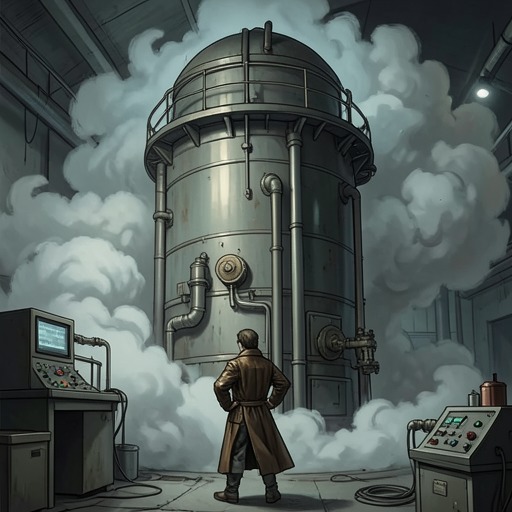
The Atmosphere Factory produces the artificial atmosphere that sustains life on Mars. Its process uses the ninth ray, separated from sunlight by instruments on the roof and stored in reservoirs occupying three-quarters of the building. Refined electrical vibrations are incorporated into the ray; the resulting compound is pumped to five principal air centers, where contact with the ether of space transforms it into atmosphere.
The plant holds enough reserve ninth ray to maintain the existing atmosphere for a thousand years. That reserve, however, cannot protect the planet if the pumping apparatus fails. The factory’s keeper explains that the danger lies in an accident interrupting the machinery, not in an immediate shortage of stored material. The distinction makes the entrance regime a matter of planetary survival: the guarded doors protect an operating system whose continued function is essential to every form of life on Mars.
Restricted Access and Physical Defenses
Knowledge of atmospheric manufacture is widely taught among Red Martians, but knowledge of ingress is not. Only two people at any one time hold the secret of entering the factory. This division separates general technical understanding from the exclusive authority to reach the protected installation.
The building reinforces that restriction with formidable physical defenses. Its walls are 150 feet thick, and a glass covering five feet thick protects the roof against aerial assault. The narrator’s host describes the structure as unassailable; attack is feared principally from Green Martians or a deranged Red Martian, rather than from ordinary means of breaching its defenses.
The Telepathic Lock and Its Custodians
The outer doors are controlled telepathically. Their locks respond to a particular combination of thought waves, making the secret of entry a mental credential rather than merely a key or spoken password. While observing his host’s thoughts, the narrator catches nine Martian sounds as the older man briefly thinks of the combination. The thought fades almost immediately, and the keeper refuses to disclose the secret, explaining that he must not reveal it.
The plant’s security depends not only on concealment but also on the custodians’ discipline. The keeper has watched the pumps for eight hundred years, working with one assistant. The twenty radium pumps are used in rotation, one at a time for a day—slightly more than twenty-four and a half Earth hours. The two men divide the watch, each spending half a Martian year, about 344 Earth days, alone in the isolated plant. Their small number and prolonged separation make stewardship a demanding, continuous obligation.
Vulnerability and Consequences
The entrance system protects against intrusion, but its concentration of access also leaves the planet dependent on a very small number of keepers. When the assistant fails to report for two days and calls from a score of capitals receive no response, a thousand cruisers search for him. His body is eventually found, and instruments indicate that air pressure is rapidly decreasing across Mars: the pumping engine has stopped. The crisis reveals the limit of physical defenses and secret access. A fortress can delay an attacker, but it cannot preserve the atmosphere once the machinery ceases to work.
The arrangement therefore joins security to a precarious form of trust. Everyone is taught the principles, yet only two people control entry; the doors themselves recognize a precise mental combination, while the plant’s operation depends on the sustained attention of its keepers. That contrast gives the access rule its significance: it guards a shared planetary necessity through exceptionally narrow custody, and the failure of one link threatens life far beyond the factory walls.